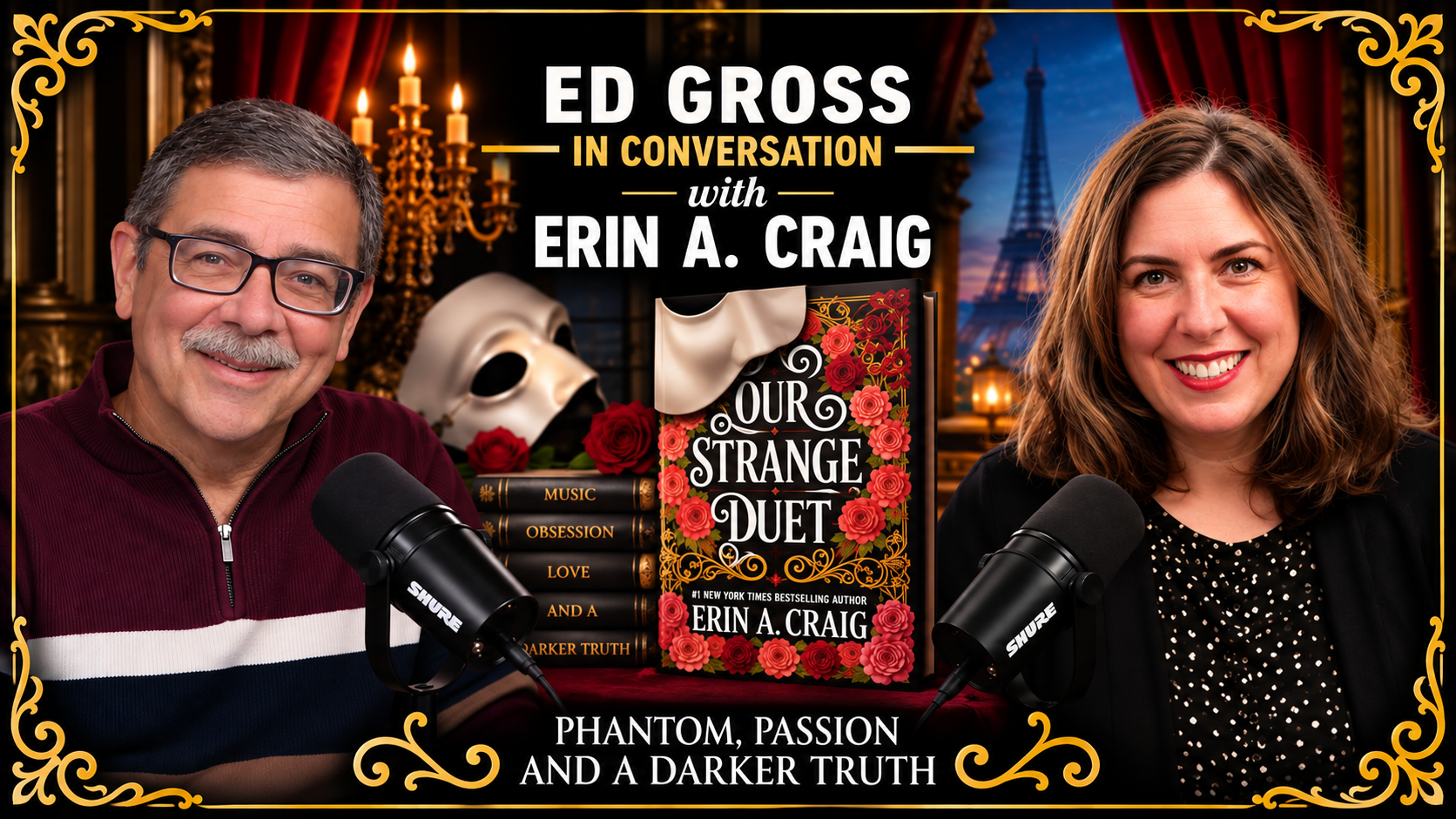
PODCAST TRANSCRIPT:
ED GROSS: My name is Ed Gross and I’m senior entertainment editor at WomansWorld.com and author of the books Superman: The Definitive History and the two volume Star Trek oral history, The Fifty-Year Mission: Our Strange Duet. It’s a phrase that perfectly encapsulates the relationship between Christine Daaé and The Phantom of the Opera. And it’s also the title of Erin A. Craig’s new novel, which was published on September 1st, about 40 years after Andrew Lloyd Webber’s legendary musical first took to the stage. Created in collaboration with Lloyd Weber Entertainment, Our Strange Duet retells and expands upon the events of the musical entirely from Christine’s point of view. Rather than attempting to reinvent a story audiences have loved for four decades, Craig steps into the spaces the stage musical doesn’t have time to explore, examining Christine’s thoughts, ambitions, desires, and relationships while filling in pieces of her life that have existed largely off stage. It’s also an unusually personal assignment for Craig, author of House of Salt and Sorrows, Small Favors, and The Thirteenth Child. What follows is our conversation on the subject.
I have to ask, how exciting is this for you, this Our Strange Duet?
ERIN A. CRAIG: It has been just the wildest fever dream. The project came together super fast. Phantom of the Opera has been near and dear to my heart since I was in eighth grade when I first heard the overture. And I was a super sporty basketball girl at the time, and I heard the overture. We were in band class, I played the trumpet very badly, but we listened to the overture and I was like, “Oh my gosh, I want to know more about this.” And so I read the book, I read the Leroux novel. I convinced my parents to take me to Toronto to go see the show. We’re in Michigan, so New York was a little too far of a drive, but we could do Toronto.
I remember sitting in the Pantages Theatre and being like, “I want to do this every day for the rest of my life. I don’t know how to do it. I’m not an actor. I’m not a performer at all.” But I ended up becoming a stage manager and I never got to call Phantom of the Opera itself, but it has always just been the show that gave me my first act. I worked all over the country for about 15 years freelancing. I worked with musicals and the Rockettes and opera companies until I had my daughter and we realized tech week schedule and sopranos singing and newborns don’t really work well together. And so I took some time away and my husband always said, “She’s going to be little this once. When she goes to kindergarten, go back to theater.” I ended up discovering I’ve always loved writing. I never thought I would do it professionally or for publication or anything, but it was always just a fun fan fiction kind of thing. While she was little, I was like, “What if I tried to write a book and get it published and that could be my thing?” Because I’m a Enneagram type three, type A person. I like to be busy doing stuff. I was like, “I can do this at home.”
I went through the query process and everything and wrote my first couple of books and coming back now with Our Strange Duet, it was just this beautiful full circle moment of the theater life kind of diverged and I took over with writing and everything, but then this brought just everything back together. It was kind of like a rediscovery of self all these years later of like, “Oh my gosh, I love this soundtrack. I listened to it in a couple years and getting back into going to see live theater and stuff again for a long time with COVID and everything, I didn’t and I had Tiny Craig at home and stuff. Now getting to introduce her into musical theater and see her love of that grow. It has just been such a joy from start to finish. I’m so grateful Andrew Lloyd Webber has changed my life twice now.
ED GROSS: Isn’t it amazing when you get to, for instance, in doing the Trek book, you interview and speak to the people you loved and connect yourself into the worlds. I’ve been very lucky to do that with most of the books is connecting into the worlds I grew up with. As a journalist, you speak to these people and you learn how they make it and all. So for you, tapping into that world that was so important to your youth must be mind-blowing.
ERIN A. CRAIG: Oh, it was wild. I actually met with Andrew a couple times as we were fleshing out ideas for the book and I was running some stuff past him. I remember, this is wildly cinematic, but I remember meeting him and we were in his apartment and the window was backlit and it was just like all of the rays of heaven had opened as he comes forward. It’s like, “Oh my gosh, it’s Andrew Lloyd Webber. You’re right in front of me. How is this real life?” And he’s been such a wonderful person to bounce ideas off of. I talked him through all of my ideas for the book and the skeleton of everything and where we wanted to not ever divert away from the musical, but just expand upon what he has in the show. Because with stage logistics and everything, there’s only so much you can do for two and a half hours for an audience’s attention span. And so getting to open up this story and because it is exclusively through Christine Daaé’s perspective, getting to see these moments where we don’t get to see on stage where she hears the Angel of Music’s voice for the first time, what happens between the chandelier crashing and the start of act two, those six months, what’s going on then?
Getting to flesh out these ideas with him, it was just so lovely and it was such a great collaborative creative discussion. It made me remember all of the production stage meetings and stuff I would do when I was a stage manager where we sat down with the set designers and the costume designers and talked through everything and it was just such a fulfilling meeting of the minds and he is so wonderfully curious. And so when we started talking about, “Well, Christine’s probably off in Deauville with Raoul during this moment.” We started talking about, “Well, what restaurants were open then?” And we started checking up all these things and the nitty-gritty stuff that my poor husband and daughter are so sick of hearing about, all these teeny tiny minutia they don’t care about. They like the show, but they’re not like, “What was Christine doing on February 18th?” All of the stuff that – Kind of minutia,
And to have someone to actually talk through all of this who knew what she was doing on February 18th, it was a wonderful process.
ED GROSS: And it’s nice when you meet your heroes and they’re not an asshole, part of my language. Exactly.
ERIN A. CRAIG: He’s everything you want him to be.
ED GROSS: That’s wonderful, seriously. What was the evolution, I guess, of the project? I mean, I get it, what you said about the collaboration and all with him, but what sparked the idea to say, “Let’s do this. Let’s take the story from her point of view”?
ERIN A. CRAIG: It’s such a fun story. So the CEO, James McKnight, the 40th anniversary is this year in October, and so a couple years ago he was thinking through how do we welcome all of this next generation? We’ve had 40 amazing years and world-record-breaking successes and stuff with the show. What do we do to welcome in the next generation of fans and how do we welcome them to the family? He met with some people at Penguin Random House and he said, “We want to commission a series of books.” Our Strange Duet‘s kind of the flagship title for everything, but there’s also a couple little golden books and there’s a gorgeous, gorgeous coffee table edition that’s coming out. But he was like, “Is this a good idea? Would you guys be interested in it?” And they’re like, “Yes, totally. This is amazing. Everybody’s the 40-year nostalgia for everything I feel like is happening this year with Polly Pocket and American Girl Doll and Phantom, all sorts of stuff.” And so they were like, “Yes, let’s do this.” And they said, “We want to bring in a big author for this YA retelling of Phantom. What are some good names?” And they started pitching around some ideas, and my editor was on the call and she said, “We’ve got this author who does. She’s kind of known for gothic atmospheric retellings.” I think she was a stage manager. I don’t know if she ever done Phantom, but we can see.
And so me just going about my life in Michigan, I got this random text from my editor just saying, “Do you like Phantom of the Opera?” And I was like, “And just word vomited at her for several texts. Then all she said was,” Okay, cool. “I was like,” What is happening? “And so we found out a couple weeks later, she said,” This whole project is happening. We’re not going to hear anything for a while. You haven’t done IP work before, but this is a long process to choose the exact fit. Just keep it in the very back burner of your mind that don’t get too excited about it. “And then in December, later that year, I got this very random request to have a Zoom call with her, and it was like,” It’s the day before Christmas break. Are we having a meeting? You should be backing out of the office early. “But she said,” Oh, you’ve got your adult debut is coming out next year. We should talk about marketing plans. “And I was like,” Should we know? This is odd. “And so we were in the middle of just catching up and everything, and all of a sudden her screen went black and she said,” Oh no, can you see me? I can’t see you. I’m blank for some reason. “And then a few minutes later it clicks on and she had changed her background to the Phantom of the Opera logo and she had the overture start playing, and it was just the most wonderfully over the top theatrical.
ED GROSS: Very over the top theatrical, but that’s awesome.
ERIN A. CRAIG: And so it was just happy tears on both sides of the camera.
ED GROSS: Like I said, whenever you could tap into these things that you love, it’s wonderful. It really is. Now I know, for instance, Stephanie Meyer is now doing. I’m not comparing this Phantom of the Opera to Twilight, okay? Don’t worry. But that being said, she’s doing a version of Twilight from Edward Cullen’s point of view, which I thought is interesting. So by doing this, by taking it from her point of view, I know you had to stay true to the story and everything else, but how does it change things? Because the perspective is different, so how does that story evolve that way then?
ERIN A. CRAIG: I think it’s wonderful, especially with this story in particular, because Christine is so central at the heart of Phantom of the Opera. She is the reason all of this is happening. But in the musical itself, a lot of it feels kind of like it’s happening around her. The Phantom’s got his agenda for her. Raoul’s got his thing, the theater managers even, and Carlotta and Piangi, all of the characters have something they want from her, and it’s kind of just happening in this chaotic world storm around her. And so getting to see and center her story and just live out that plot line through her head, we get to see all of her emotional dilemmas, and we see there’s so much, especially in the final confrontation in act two, where we see her make her choice. We hear all the beautiful music, we see how torn she is, but to actually be in her head and hearing all the inner thoughts and the dialogue and the, “Gosh, I want to do this, but I want to do that. What guy do I end up with? Should I go off and leave them both?” All of these things, it’s a new way to really see the plot evolve through her perspective.
And then because it is a book and we’re able to expand on the story, we do get to see so much of what’s going on that we don’t see what’s happening on stage. So in the scene with “Prima Donna“, and we see Carlotta’s big glory moment, she’s returned to the opera and they’re all fawning over her. Christine’s not in that scene, so we don’t see that scene in the book. She’s at her house. She’s just got back from meeting the Phantom of the Opera going to his layer for the first time, and she’s at home making tea and has to hear about it from Meg later on and Raoul. In a weird way, it was really satisfying. What kind of throw pillows does Christine Daaé decorate her flat with? And then just getting –
ED GROSS: Erica wants to know. The world wants to know.
ERIN A. CRAIG: Exactly. They’re really pretty. So it was really fun to show all of these things. And also, I’ve always been, because I saw the show first when I was 13, I’m definitely team Phantom. I like The Dark Mysterious Man, but being in Christine’s head, I had to justify why Raoul is such a compelling romantic choice, which I’ve never wanted to do before. He’s always been kind of this milquetoast version of Phantom. But it was really lovely to go through and like, “Okay, this was her first love. What did that look like? What was their relationship like before the opera house, before all of these terrible things happened and put them in this perilous situation that they’re in?” And getting to see how lovely that first love could be and why she is drawn to that. It is a safer, simpler choice, but it’s a choice that makes her happy. She has good memories of him. Her father was alive when they were together the first time, and so all of that, it made a really compelling choice for Raoul. And at the end of it, I was like, “Maybe she did make the right choice. Maybe teenage Erin was wrong.”
ED GROSS: Maybe you convinced yourself that that’s the right choice.
ERIN A. CRAIG: And then in the audiobook, we’ve got Jordan Fisher playing Raoul. So it was like, “Oh, well, that’s even more compelling ever since.”
ED GROSS: Now he really has to be with him. I understand. Exactly. You pointed out, I mean, everybody points out it’s 40 years, the 40th anniversary, but so much in society has changed. Women’s roles have changed in a lot of way. We’ve gone through and come out the other side, hopefully, of the Me Too movement and all that stuff. So how does, or do you just ignore it? Does Christine change over the course of these 40 years in approaching that character in this story? Do you have to adjust for the changing era?
ERIN A. CRAIG: I don’t think, honestly, at heart she has changed much. I think the way that we are seeing her has changed, but I think her character was always there. It was just waiting to be discovered. When I was approaching all of the parts that happened before that overture starts and everything, and looking at the scenes I wanted to tackle and all of her backstory, her life and everything, her father dies when she’s 16. She’s in Paris. She’s thankfully with the Girys, they’re old family friends and everything, and her father gets sick and dies very unexpectedly. She’s got her life has just been rocked. Her whole reason for everything, her provider, her father, her best friend, everything is gone. After the funeral, Madame Girys was like, “What are you going to do now? You don’t have a mom, you don’t have an inheritance to fall back on.
There’s not a lot of choices for women in this position in 1890s France. What’s next?” She very kindly offers to take Christine under her wing and says, “You can come to the ballet school. I can teach you how to dance. Maybe you can make it into the ballet chorus, quartz the ballet and everything.” I think that moment that Christine says yes, and she chooses that, she could have become a shop assistant or sell flowers on the street. She could have gone and become a French prostitute as one would do in the 1890s. There was a lot of easier ways that she could have made her way through, but she hadn’t been a ballet dancer. She hadn’t trained for this. She always liked music and things, but this was not a career path that she was inclined toward, but she said yes to that.
I think that her being the ballet girl that we see in act one from the get-go already said so much about her before the show even starts. We know so much about her, but because it’s, “Oh, she’s not the prima donna, she’s not this, she’s not that yet,” so much of it is just kind of like, “Oh, she’s just coasting through life.” But she made that choice to go into theater. That’s not an easy path. Blessedly, when I decided I was going to be a stage manager, my parents were like, “Yes, go do that. It’ll be great. I’m not worried at all about your financial situation later in life.” But she’s very secure. “This is going to be great. 401(k)s are fun. But Christine decided,” Yes, this is the path I want to go down. “And I think telling her story now 40 years after and getting to have that moment with her and have that first flicker of ambition and give it its own little moment to glow, I think we get to see her in the light that she’s always been there, but there’s just been so much of the story has been on top of it. It’s a hard little glow to see when there’s so much stage light around her.
ED GROSS: Because we’ve seen with the show and most of the versions, you get really so much of it is the Phantom’s point of view of things, right? So when you’re writing the novel from her point of view, does the phantom change at all? I mean, what is his sort of evolution in this new medium or this new approach, I should say?
ERIN A. CRAIG: It was really fun because we’re in her head and it’s her perspective, it’s her point of view, it’s her dark dreams and desires and everything. He can be so much more than what we even see on the stage. He’s always been kind of this mythical legendary figure, very mysterious. I remember some of my editor’s notes, “Does he actually have magic? How are these fireballs shooting out of a staff and everything?” And I wanted to have Christine see him as both. He is this very mythical, magical, supernatural force to begin with. She thinks at one point that it’s the ghost of her father and then it’s the angel of music and it’s all these things. And then I did want to strip it away and he’s a man, this is how he’s doing it. We get to see she wanders through his basement world and sees him tinkering with the automatons and the actual cogs and wheels of how he does all these magic tricks and things to give. It is a man, he’s a genius, but it’s a man at the end of the day.
But to be in her head and to have those. Raoul was the first love. I think Phantom’s the first time she felt true desire and passion and the emerging of her sexuality and all of that. And so because we’re in her head, we get the first kind of woo dream of what could be under that mask and all these things. But then we do see him as he truly is, and I think that’s so lovely at the end when we’re in the final confrontation moment, both Raoul and Phantom are completely stripped away of everything. Raoul’s not a viscount. He’s just a guy hanging by the end of a rope struggling for the girl he loves. The Phantom is a very tortured, complicated man standing before her just offering his heart. And so I love the journey that Christine goes through and all of the various versions that she sees of him from the absolute pinnacle of possibility to he’s a guy who loves her a lot and maybe not in the best healthiest way, but he’s out there, he’s trying, he’s putting his heart on the table.
ED GROSS: Phantom himself though has gone through, I don’t even mean in your novel, but in general through such a metamorphosis or an evolution from the more monstrous versions we were getting early on to where he’s the romantic lead, even with those issues, like you said, perhaps not the healthiest romantic lead, but he becomes this romantic lead. So it’s sort of an interesting journey that that character has been on through all these years, basically.
ERIN A. CRAIG: Absolutely. And I think that was so infuriating to me as a teen experiencing the show for the first time. I was like, “Yeah, he kind of killed a couple people and stuff, but he’s not that unattractive. You see this Gerard Butler version, he’s got a sunburn. It’s fine. Why are you choosing Patrick Wilson over Gerard Butler?”
ED GROSS: Being a stage manager yourself and having the background you have, it’s one thing to be a fan of Phantom of the Opera to come into this project, but then to have that background on stage in opera and that sort of thing, what does that give you in terms of an insight in writing this book?
ERIN A. CRAIG: I mean, it definitely helped inform all of the Opéra Populaire scenes going through and actually talking about in theater terminology the way professionals do. We’ve got the wings, the flies, all of the different trapdoors and everything. Just from a strictly technical standpoint, I never had to seek out the terminology. I never had to call somebody and be like, “What is this thing called?” Or anything like that. The one part actually that I did need help with, because as a stage manager, you’re there from the very beginning of the conception of the piece until closing night and after with Strike and everything.
But the one part I never did know about was what happens in a vocal coaching because stage managers aren’t there for that. That’s the singer and their pianist, their vocal coach, sometimes the maestro, but I would never have been in that. And so I called actually one of my former sopranos and I said, “I cannot tell you anything about why I need to know this, but could you teach me how to sing as a soprano?” And she was like, “Professionally?” I was like, “No, no, no, just walk me through it.” And no one needs to hear me sing, but walk me through what you would go through in a vocal coaching session. There are warmups, I assume. How do you do a music rehearsal? And so that was really fun to be able to use old resources and stuff to get a new perspective for me, what happens in the life of a soprano. But it was really lovely to just take the world that I was very familiar with and welcome readers into a space that the vast majority of people haven’t pulled a fly rail coming in, have the battens coming in and everything and all of that. And knowing just all of the old school technical theater tricks and things about limelights and how you would do the footlights for the gas lines and all of that stuff. It was really fun to dig through all those glory days of college history of Theater 101.
ED GROSS: Absolutely. Hey, it’s good when the background can come back into play in doing this. There was such a fascination with that whole. I mean, I’m lumping it all together into romantasy, but that whole idea, I mean, I loved in the ’80s, the Beauty and the Beast TV show, right? Oh,
ERIN A. CRAIG: Ron Perlman and Linda Hamilton.
ED GROSS: Oh my God. I wrote a book on that too. But it was so good. The show was such a magical show until the third season they killed Catherine and then everything went crazy. Well, she wanted off the show and she got pregnant and they had to get rid of her. One of the writers told me they got pissed at her, so they gave her a particularly brutal death.
ERIN A. CRAIG: I remember that. That was
ED GROSS: So shocking.
ERIN A. CRAIG: Yeah.
ED GROSS: It really was. But in any case, so the romantasy thing, whether it’s Phantom of the Opera, Beauty and the Beast, Buffy and Angel, I mean, what is the appeal, do you think, of these sort of star crossed lovers or world crossed or whatever the heck you want to call it?
ERIN A. CRAIG: I think a lot of it, it’s a safe way for. Because the vast majority of the audiences are young women, and I think it’s a safe way to start to explore other romantic possibilities, and it could be as crazy as a Lion Man in the sewers of New York. But you always have, even when you go through Gilmore Girls, you’ve got the very safe first boyfriend, Dean, and then the second one, it’s Jess, and he’s got the dark hair, and he drives the motorcycle, and he reads Bukowski. I think the allure of that mysterious unknown other is so appealing to young girls and women as people are coming of age and figuring out who they want, what they is. It’s fun to explore that. And I think books and movies and TV shows and stuff give us a way to explore what it would be like to be dated by a 200-year-old vampire in a trench coat and thanks and things. I think there’s so many. First loves are always kind of like the blonde hero that you see. It is lovely to have a safe way to explore what other possibilities there are in life.
ED GROSS: Yeah, no, absolutely. And the vampire romantasy is insane. I couldn’t believe when I started researching how many there are. Holy God.
ERIN A. CRAIG: Wild. I’ve been going to a lot of romantic cons with fabled fantasies. There’s so much fun. If you ever get the chance to experience one, it’s wild. But yeah, they would be like, “Oh yeah, my book boyfriend is a hot immortal vampire. Which one doesn’t narrow it down.
ED GROSS: The novel was 1909 or 1910 and here we are in 2026, and we’re still doing versions of Phantom of the Opera, your book being the latest. What is it about this story? Why does it go on the way it does?
ERIN A. CRAIG: I think there’s just something enchanting about it. Leroux was inspired. I think actually we were in the hundredth year anniversary of it, I think, the counterweight crash—or I guess it would be 150 years. I don’t know. There was some big anniversary this year about the –
ED GROSS: Something went on.
ERIN A. CRAIG: He was inspired to write this story because he heard this story about the Palais Garnier, about the counterweight of the chandelier crashing, and it actually did kill, I believe it was an usher who was setting up for the show that night. And he was like, “What if this weird, mysterious creature who lived in the bowels of the opera house dropped the chandelier on purpose and he was off to the races?” But I think there is something about just the world of it, and the Palais Garnier, which becomes Andrew used for the Opéra Populaire as heavily basis upon. There’s something fun about theater. It is such a weird way to make your living in life. And I think people who have normal, prosaic day jobs, it is mysterious and beguiling and dazzling. And then to throw in a murder plot or a grand romantic gothic story about someone who would choose to inhabit the opera without being part of the opera, and then just a peek into the performer’s lives. I think it sets it up already.
And then when you get to 1986, when Andrew’s version of it debuted, the music, it draws you in. It’s so inescapable. One of the things I’ve loved about doing all of the early events and stuff for the thing is getting to hear people’s memories of the Phantom, because it is such a visceral part of our cultural society now. And they have just such the loveliest stories about like, “Oh, my parents had it on vinyl. They’d dance around all I can ask of you in the dining room, kitchen, all this stuff.” And getting to be the keeper of all these stories for how they came to the show, how they know the show, like, “Oh, my grandparents took me to see it.” Or I was just talking to a woman who she would always listen to as she was going to sleep. And so the first time her parents took her to see the show when she was a kid, she actually fell asleep because that was her comfort music and everything. It’s so wonderful to see all of just the myriad of ways that people have connected to the show and continue to hold it so treasured in their heart. You say Phantom of the Opera and there’s a memory there, whatever it is, good or bad, it’s there and people have it very viscerally.